Blog 2: Idea Selection and Practicals
- amuhsin23
- May 22, 2024
- 4 min read
Updated: May 25, 2024
Welcome back to my blog!!!!!!
For this week's blog I hope to cover what I have done for my ICPD lessons and how my team decided on what ideas we should work upon and what ideas we should throw away for our chemical device the ✨ALGAE BIOREACTOR✨. However to explain some of our thought process we first need to look at the practical sessions we did for ICPD.
Practical 1
For our first practical we were introduced to a coffee machine and we were tasked with finding out how this chemical device functioned. Below are the steps we discovered on how the coffee machine works as well as a schematic that was drawn by yours truly.

After adding water and coffee powder, then turn on the coffee maker. The water heats up and boils, turning into steam 💧💨. This steam, being less dense, rises and is directed by a one-way valve. The steam pushes the hot water up through a tube, spraying it over the coffee powder. The hot water extracts the coffee flavors and drips into the pot. ☕ This process is called an air lift mechanism.
In the second experiment, we used an airlift pump and calculated the flow rate and plotted it against the submission ratio. below is the graph we ended up with.

We can see a clear trend in how as submergence ratio increases the flowrate also increases. As such we can conclude having less pipe exposed above water will improve the efficiency of the airlift pump.
After doing all of that we were finally done for practical 1. And lastly I just want to thank my team because without them I would have probably gone insane with just how many times we had to fill up the tube and empty it over and over again 😭😭😭

Coming up with ideas
Our journey began with a brainstorming session on MIRO, where we unleashed our creativity and filled the board with sticky notes. Given that we already had a clear vision for our chemical device—a bioreactor for algae cultivation—our team quickly generated a plethora of ideas. In total, we came up with 25 unique concepts. Here they are in all their glory:
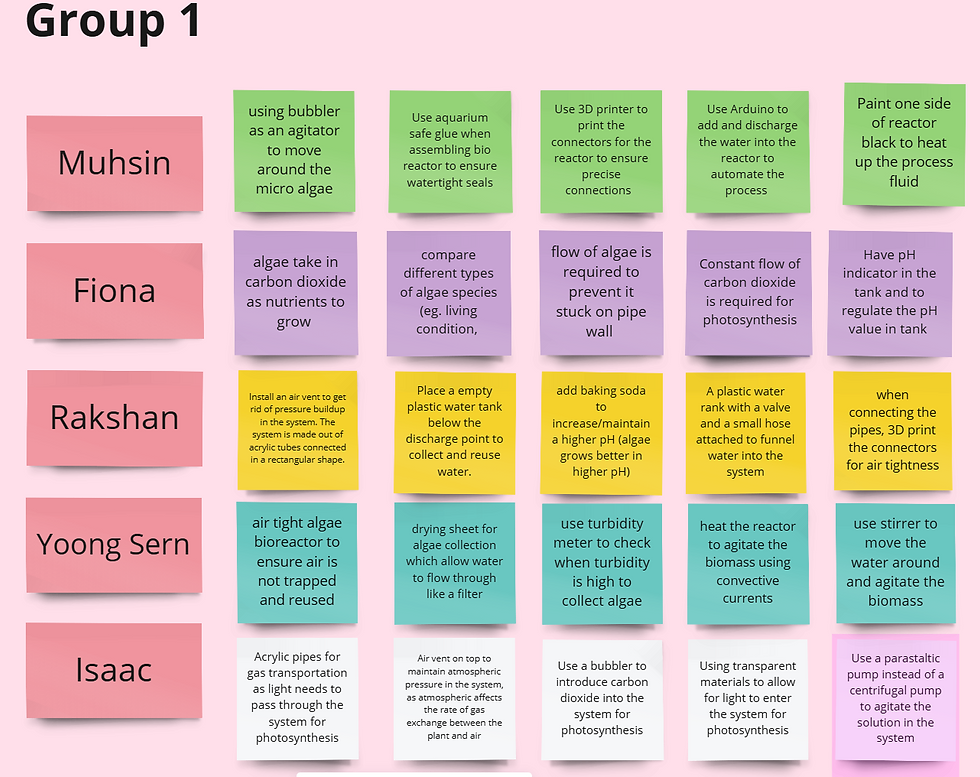
It is my humble opinion that of the 25 ideas that my team came up with I would say only 3 of them are actually not good and of theses 3 only 1 of them is genuinely bad. I will expand upon these 3 idea in a later. Since I found 88% of our ideas good it was very hard for me and especially my team to narrow down our ideas to the best one however we did manage to do it in the end.
Narrowing the ideas
To narrow down the ideas we had to reject some ideas as such we took into consideration the Time, Budget, Technical and Operational to implement the ideas. The first 2 make sense as this project has a deadline and a specific budget as such ideas like "use turbidity meter to check when turbidity is high to collect algae" would take too much time to implement and ideas like "Have pH indicator in the tank and to regulate the pH value in tank" would take too much money to implement. As such these ideas were rejected.
However what about the Technical and Operational criteria? These criteria were made because some ideas are feasible with the time constraints and budget but they cant be done because we don't have the necessary skills to do it or we don't have the relevant equipment to do it. These criteria eliminated ideas like "Use a peristaltic pump instead of a centrifugal pump to agitate the solution in the system" and "heat the reactor to agitate the biomass using convective currents"
After doing all of this we were left with the best of the best ideas we had. Combining the remaining ideas into 5 different design pitches and to determine the best option, we used COWS🐮)decision matrix.
(Also known as Criteria Options Weighing Score)
This method involved evaluating each design against a set of criteria and assigning scores accordingly. After thoroughly tallying the results, we identified the best design was to have a system that is made out of rigid acrylic tubes connected in a loop in a rectangular shape. Using a bubbler connected to the system as an agitator to move the microalgae around the loop so that they do not stick to the walls of the bioreactor. This generates a system that makes algae easily harvestable.
Now for the last section of this blog i want to explain what I did for my practical 2
Practical 2
For this practical we were tasked with designing a shark and constructing it from cardboard. The shark also needed to have a joint. Unfortunately most of my groupmates (including me) are not gifted in the arts. Below is our initial design.

Luckily one of my teammates Fiona was gifted in the arts and she came in clutch and designed everything.


However this was not the hardest part. It was transferring the drawings from the paper to the cardboard. It nearly took us 2 Hours to do this. However when all was said and done we were left with something that in my opinion was perfect.

What makes it more impressive is that we used no glue to achieve this. We only needed to use the tab-n-Slot method and brass fasteners to secure the joints.
Overall I think that this practical has thought me a lot especially on how to manage projects in a team and how to delegate the tasks effectively.
Anyway that's all that I have for this week. Goodbye. 👋🏿👋🏿👋🏿


Comments